




Cleaning a whole branzino can feel intimidating the first time you place one on your cutting board. You may not know where to start, whether the scales need to come off, what to do with the gills, or how to remove the internal organs without damaging the fish.
The good news is that cleaning branzino is much easier once you understand the basic steps. With a sharp knife, kitchen shears, and a fish scaler, you can prepare a whole branzino at home without complicated equipment or professional fish-cleaning skills.
The most important thing is to work slowly and know which parts actually need to be removed. Before you start, check whether your fishmonger has already scaled or gutted the fish. Then work through the preparation step by step: remove any remaining scales, trim sharp fins if needed, remove the gills, open the belly cavity, take out the internal organs, and check the fish carefully before cooking.
In this guide, you will learn how to clean branzino from start to finish, including what you should remove, what you can leave intact, how to tell when the fish is properly cleaned, and how to handle it safely.
Quick Answer: How Do You Clean Branzino?
To clean a whole branzino, first remove the scales from the tail toward the head. Trim any sharp fins if needed. Then remove the gills and open the belly cavity. Take out the internal organs and clean the cavity. Check for missed scales or tissue, then pat the fish dry.
You can cook the cleaned branzino whole or continue with the filleting process.
What Is Branzino?
Branzino is the Italian name commonly used for European sea bass. You may also see branzini used as the plural form.
Branzino has mild, white flesh and a delicate texture. It can be cooked whole or cut into fillets.
When you buy a whole branzino, check what work the fishmonger has already done. The fish may already be scaled, gutted, or trimmed.
If it is already cleaned, you may only need to inspect it and prepare it for your recipe.
What Does “Cleaned Branzino” Mean?
A cleaned whole branzino usually has its scales and internal organs removed. The gills may also be removed. Sharp fins can be trimmed if needed.
Cleaning does not mean removing all the bones.
The backbone and other bones remain when you prepare the fish whole. Removing the bones is part of the filleting or deboning process.
This distinction is useful when buying whole fish from a seafood counter.
Cleaning vs. Filleting Branzino
| Task | What it means |
| Scaling | Removing the scales from the skin |
| Gutting | Removing the internal organs |
| Degilling | Removing the gills |
| Trimming | Cutting away unwanted or sharp fins |
| Filleting | Removing the meat from the bones |
| Deboning | Removing small bones from the fillets |
If you want to cook the fish whole, you normally do not need to fillet it.
If you want boneless portions, you can continue with the filleting process after cleaning.
What You Need to Clean Branzino
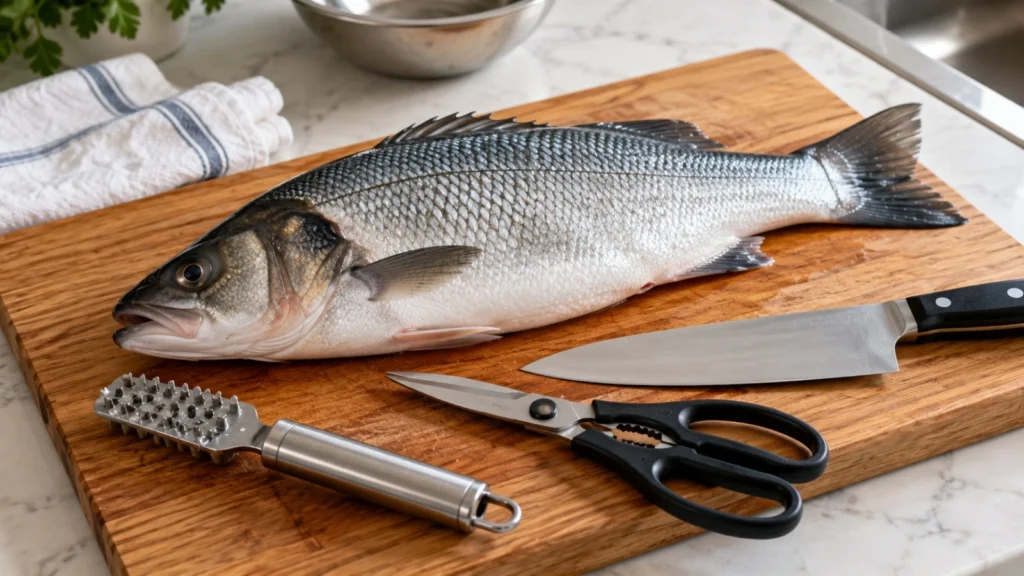
You do not need many tools to clean a branzino.
Gather these items:
- A sharp kitchen knife
- Kitchen shears
- A fish scaler or the back of a sturdy knife
- A large cutting board
- Paper towels
- Disposable gloves, if preferred
- A bowl or bag for fish scraps
A fish scaler can make removing scales easier. However, you can also use the back of a sturdy knife.
Use a clean cutting board for raw seafood. Keep the raw fish away from foods that are ready to eat. The FDA recommends using separate surfaces or cleaning them thoroughly between raw seafood and other foods.
How to Clean Branzino Step-by-Step
1. Prepare Your Work Area
Place the branzino on a clean and stable cutting board.
Keep your knife, kitchen shears, paper towels, and other tools nearby.
You can work near the sink when removing scales. This can make it easier to collect loose scales.
Be careful when handling the fish. Some fins and bones can be sharp.
If the branzino is frozen, thaw it safely in the refrigerator. The FDA recommends thawing frozen seafood gradually in the refrigerator.
2. Check the Fish Before Cleaning
Look over the whole branzino before you start.
Check the skin, fins, gills, and belly cavity. If the fishmonger has already scaled and gutted it, you may not need to repeat those steps.
Fresh seafood should have a fresh and mild smell. It should not have a sour, rancid, strong fishy, or ammonia-like odor.
If the fish has an unusual or unpleasant odor, do not eat it.
3. Remove the Scales
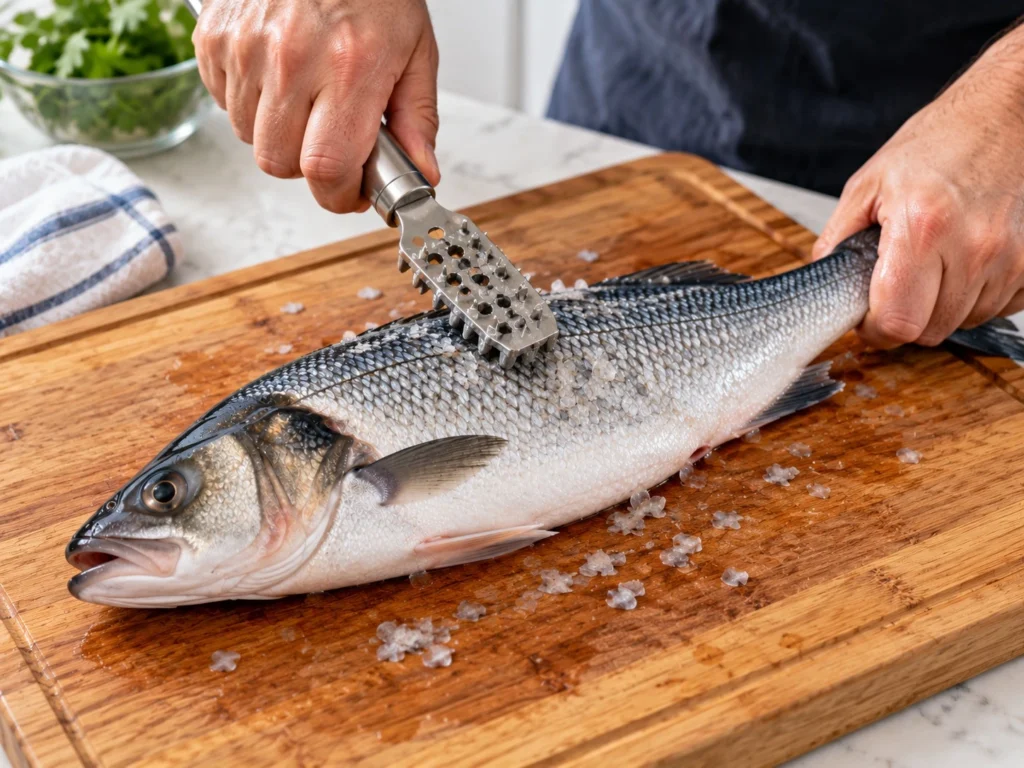
Scaling is one of the first steps when cleaning whole branzino.
Hold the fish firmly by the tail.
Use a fish scaler or the back of a knife. Scrape from the tail toward the head. Work in short and controlled strokes.
You are scraping against the natural direction of the scales.
Cover the entire side of the fish. Pay close attention around the belly, fins, and gill cover. Small scales can remain in these areas.
Turn the fish over and repeat on the other side.
Do not press too hard. You want to remove the scales without damaging the skin.
4. Check for Missed Scales
This step is easy to skip, but it is important.
Run your fingers gently over the skin. Move against the direction of the scales.
The skin should feel smooth.
If you feel rough areas, scrape those sections again.
Check these areas carefully:
- Around the fins
- Near the belly
- Behind the gill cover
- Near the tail
Once the skin feels smooth, move to the next step.
5. Trim the Fins if Needed
Use kitchen shears to trim sharp fins.
You can trim fins along the top, sides, and underside of the fish if they make the fish difficult to handle.
This step is optional. It depends on how you plan to cook the branzino.
Be careful when cutting. Some fish fins contain sharp spines.
6. Remove the Gills
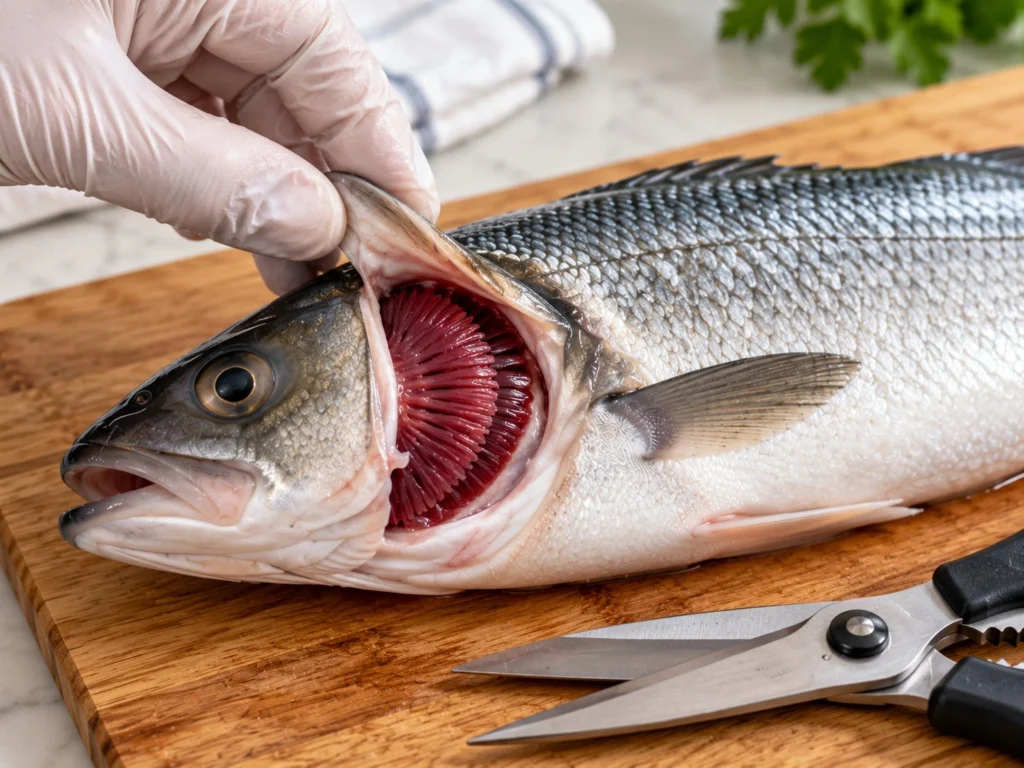
If the gills are still attached, remove them before cooking.
Lift the gill cover on one side of the fish. The gills are the red or dark, comb-like structures inside.
Use your fingers, knife, or kitchen shears to free the gills from their attachment points.
Pull them out carefully.
Check the other side as well.
Some fish are already degilled by the fishmonger, so check before removing them.
7. Open the Belly Cavity
Place the branzino belly-up.
Find the small opening near the rear of the belly.
Insert the tip of your knife carefully.
Make a shallow cut toward the head. Do not push the knife too far into the fish.
The goal is to open the belly without cutting deeply into the internal organs.
Take your time. A shallow cut gives you better control.
8. Remove the Internal Organs
Open the belly cavity with your fingers.
Carefully pull out the internal organs.
Some tissue may remain attached. Use your knife or kitchen shears to remove it.
Try not to puncture the organs while removing them.
A shallow belly cut makes this step easier and cleaner.
Once the organs are removed, inspect the cavity.
You should be able to see the inside of the fish along the backbone.
9. Clean the Belly Cavity
Check the cavity carefully.
Remove any remaining organs, membrane, or unwanted tissue.
Pay special attention to the area along the backbone.
The cavity should be clean before you cook the fish.
Some traditional branzino cleaning methods use running water to clean the inside of the fish after gutting. However, rinsing raw seafood is not a food-safety requirement. If you choose to rinse the fish as part of your cleaning method, avoid splashing raw fish juices around the kitchen and clean the sink and nearby surfaces afterward.
10. Check the Fish One More Time
Inspect both the outside and inside of the branzino.
Look for:
- Loose scales
- Remaining organs
- Small pieces of tissue
- Sharp pieces of fin
- Any other unwanted debris
Remove anything you find.
This final check helps make sure your branzino is ready for cooking.
11. Pat the Branzino Dry
Use paper towels to dry the fish inside and outside.
Pat the skin gently until it is dry.
Drying the fish before seasoning also helps with browning and crisping during cooking.
Your branzino is now cleaned and ready for your recipe.
How to Tell When Branzino Is Properly Cleaned
Your branzino is ready when:
- The scales have been removed.
- The skin feels smooth.
- Sharp fins have been trimmed if needed.
- The gills have been removed if they were still attached.
- The belly cavity is empty.
- No internal organs remain.
- No unwanted tissue remains inside.
- The fish has been patted dry.
If you run your fingers over the skin and feel rough areas, check for missed scales.
If you see organs or large pieces of tissue inside the cavity, remove them before cooking.
Do You Need to Remove the Head?
No.
You do not need to remove the head if you plan to cook the branzino whole.
The head and tail can remain attached during whole-fish cooking.
If you want fillets, the head is normally removed as part of the filleting process.
Do You Need to Remove the Skin?
No.
You can leave the skin on branzino when cooking it whole.
The skin can become nicely browned and crisp when cooked properly.
If you are making fillets, you can keep or remove the skin depending on your recipe and preference.
Do You Need to Remove the Bones?
No, not if you are cooking the fish whole.
Cleaning removes the scales, internal organs, and other unwanted parts.
The backbone and smaller bones remain in a whole branzino.
If you want boneless portions, you need to fillet and debone the fish.
Do You Need to Fillet Branzino After Cleaning?
No.
You can cook a cleaned branzino whole.
Whole branzino is commonly prepared by baking, roasting, or grilling.
If you want separate portions, you can continue with the filleting process.
For fillets, you will remove the meat from the backbone. You may also need to remove the rib bones and pin bones.
Cleaning prepares the fish for cooking.
Filleting turns the whole fish into separate portions.
Cleaning Branzino for Whole-Fish Cooking vs. Fillets
The cleaning process is similar for both methods.
For whole branzino
The basic process is:
Scale → gut → remove gills → trim fins if needed → clean → dry
For branzino fillets
You continue with:
Scale → gut → remove gills → fillet → remove rib bones → remove pin bones
If you plan to fillet the fish, keep your knife sharp and use controlled cuts.
How to Prepare Cleaned Branzino for Cooking
Once your branzino is clean, you can prepare it for your recipe.
Pat the skin dry before seasoning.
You can then:
- Score the skin with shallow cuts.
- Season the outside.
- Season the belly cavity.
- Add lemon or fresh herbs.
- Brush the skin with oil.
- Bake, roast, or grill the fish.
Avoid making deep cuts into the flesh.
Shallow cuts can help seasoning reach the surface and can also help the skin cook evenly.
Can a Fishmonger Clean Branzino?
Yes.
Many seafood counters can prepare whole fish for you.
You can ask the fishmonger to:
- Scale the fish
- Gut the fish
- Remove the gills
- Trim the fins
- Fillet the fish
If you want to cook the branzino whole, you can ask:
“Please scale and gut the branzino. Leave it whole.”
If you want fillets, ask the fishmonger to fillet it instead.
When you get home, check the fish before cooking. The fish may already be completely prepared.
How to Store Cleaned Branzino
Keep raw branzino cold after cleaning.
Store it in a refrigerator at 40°F (4°C) or below. The USDA recommends using or freezing raw fish within 1 to 2 days.
If you will not use the fish within that time, freeze it properly.
Keep raw branzino away from cooked food and other ready-to-eat foods. This helps reduce the risk of cross-contamination.
Do not leave raw fish at room temperature for more than 2 hours. If the temperature is above 90°F, the limit is 1 hour.
Food Safety Tips for Cleaning Branzino
Raw seafood needs careful handling.
Follow these simple rules:
- Keep branzino cold before cooking.
- Wash your hands after handling raw fish.
- Use a clean cutting board.
- Keep raw seafood away from ready-to-eat foods.
- Clean knives, boards, sinks, and counters after preparing the fish.
- Do not leave raw fish at room temperature for more than 2 hours.
- Refrigerate seafood at 40°F or below.
- Cook finfish to a safe internal temperature of 145°F.
The FDA recommends cooking finfish to an internal temperature of 145°F (63°C). A food thermometer is the best way to check the temperature.
Common Mistakes When Cleaning Branzino
Scraping Too Hard
Too much pressure can damage the skin and flesh.
Use firm but controlled strokes when removing scales.
Cutting the Belly Too Deep
A deep cut can damage the internal organs.
Make a shallow incision first. Open the cavity slowly.
Leaving Scales Around the Fins
Scales can hide around the fins and gill cover.
Always check these areas before cooking.
Forgetting the Gills
If the gills are still attached, remove them before cooking the whole fish.
Not Checking the Cavity
After removing the organs, inspect the belly cavity again.
Small pieces of tissue can remain inside.
Not Drying the Fish
Pat the fish dry before seasoning and cooking.
Dry skin helps with browning and crisping.
Cross-Contaminating Other Foods
Do not use an unwashed cutting board or plate for cooked food after it has held raw fish.
Wash your hands, utensils, boards, and work surfaces after handling raw seafood.
Frequently Asked Questions About Cleaning Branzino
How do you clean branzino fish?
To clean branzino, remove the scales, trim sharp fins if needed, remove the gills, open the belly, and remove the internal organs. Clean the cavity and pat the fish dry before cooking.
Do you have to scale branzino?
If the branzino still has scales, remove them before cooking when your recipe calls for a scaled fish. Check the fish first because a fishmonger may have already scaled it.
How do you remove scales from branzino?
Use a fish scaler or the back of a sturdy knife. Hold the fish firmly and scrape from the tail toward the head. Check the skin with your fingers when finished.
Do you gut branzino before cooking?
Yes. A whole branzino is normally gutted before cooking. Remove the internal organs and clean the belly cavity before preparing the fish.
Do you remove the gills from branzino?
If the gills are still attached, remove them before cooking. Check first because a fishmonger may have already removed them.
Can you cook branzino whole?
Yes. Branzino can be cooked whole after it has been scaled and gutted. You can bake, roast, or grill it with the head and tail still attached.
Can a fishmonger clean branzino?
Yes. Many seafood counters can scale and gut whole fish. Ask for the preparation you need before taking the fish home.
Is branzino the same as European sea bass?
Branzino is the common Italian name used for European sea bass. The plural form is often written as branzini.
Do you need to fillet branzino?
No. You can cook cleaned branzino whole. Filleting is only needed when you want separate portions.
Do you remove the skin from branzino?
No. The skin can remain on when cooking branzino whole. It can become crisp when cooked properly.
Do you need to remove the head from branzino?
No. You can leave the head attached when cooking branzino whole. It is normally removed when preparing fillets.
Does cleaning branzino remove the bones?
No. Cleaning removes scales, gills, and internal organs. The backbone and other bones remain unless you fillet and debone the fish.
How long can cleaned branzino stay in the refrigerator?
Keep raw branzino at 40°F (4°C) or below and use or freeze it within 1 to 2 days.
Final Thoughts
Learning how to clean branzino becomes much less intimidating once you understand what you are looking at and what needs to be removed. The process is straightforward: scale the fish, trim sharp fins if needed, remove the gills, gut the fish, clean the belly cavity, inspect it carefully, and pat it dry.
If you plan to cook the branzino whole, there is no need to remove the head, skin, tail, or backbone. If you want individual portions, you can continue with filleting and deboning after the cleaning process.
One practical lesson is to always check what your fishmonger has already done before you start. A whole branzino may already be scaled, gutted, or degilled, which can save you time and unnecessary work. If you are cleaning your first whole fish, take your time rather than trying to rush through the process.
With practice, the steps become familiar, and preparing a whole branzino at home becomes a much more manageable part of cooking seafood. At OceanCraving, we focus on making branzino easier to understand and prepare with practical instructions, clear explanations, and responsible seafood-handling guidance, so you can move from buying a whole fish to preparing it for the table with confidence.
